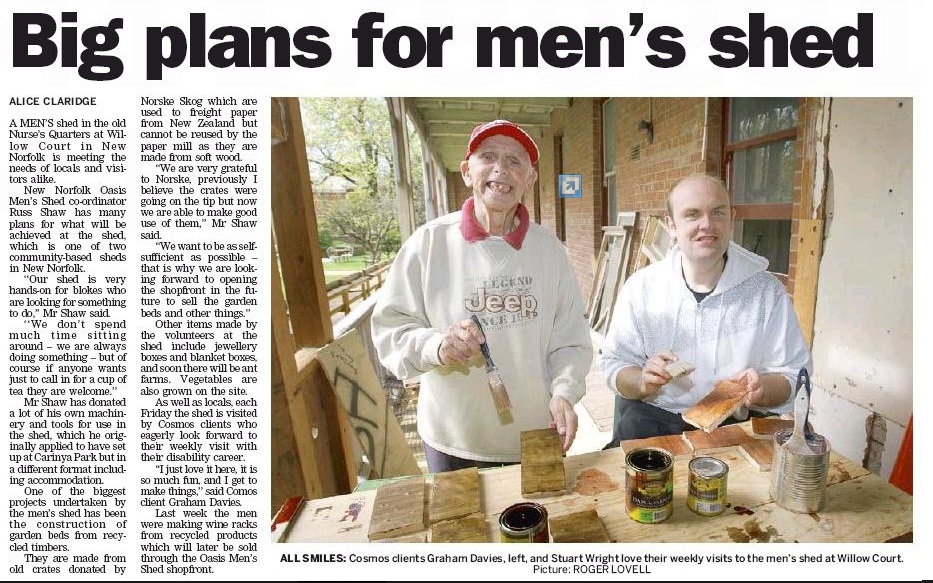
Willow Court Working bee
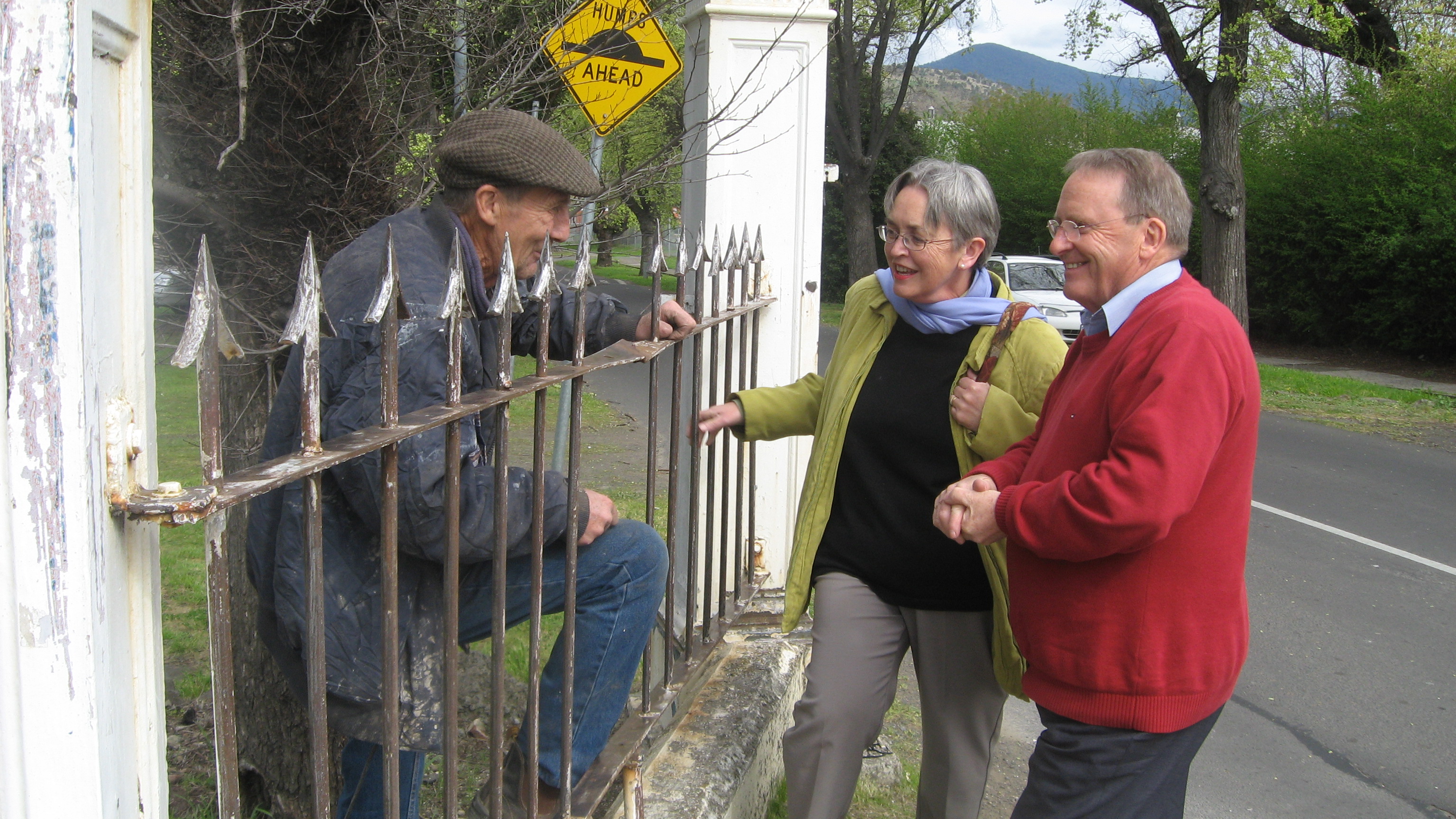
Dr. Dianne Snowden and Hon. David Llewellyn AM talking over restoration with Rod Quarrel at todays working bee.
 Audio here https://willowcourttasmania.org/audio-documentaries/
Gallery here: https://willowcourttasmania.org/pictures/working-bee-gallery/
Media Release here: https://willowcourttasmania.org/education-and-media-packs/media-releases/
New Norfolk News:http://www.newsnn.net/2012/10/friends-tackle-fence.html
Formal Minutes of the DVC August
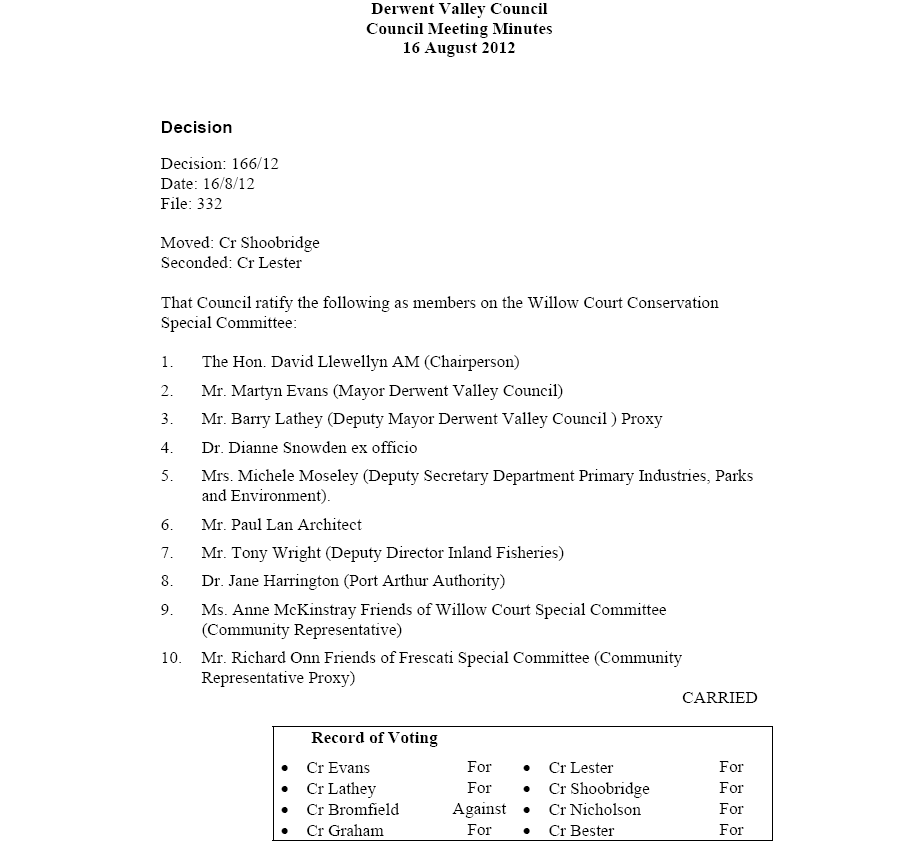 http://www.derwentvalley.tas.gov.au/webdata/resources/files/16%20August%202012.pdf
At last, the minutes of the DVC August meeting have appeared on the DVC website, we can now see the formal document and who voted which way. The minutes also have approval for stage five in the subdivision opposite Royal Derwent Hospital. Names are suggested for some of the streets, it would be nice to see a street name that recognises the history from the Residents side. What would be a good name?
New Short Film
I have just uploaded a new short film (21 min) of footage I had on one of the Royal Derwent visits, Most of these buildings are gone now except for the Chapel and Ward 10. Images of the past. Royal Derwent Hospital, Wards 7,8,3,4,10 and the Chapel. http://
[nggallery id=8]
A new Willow Court Site
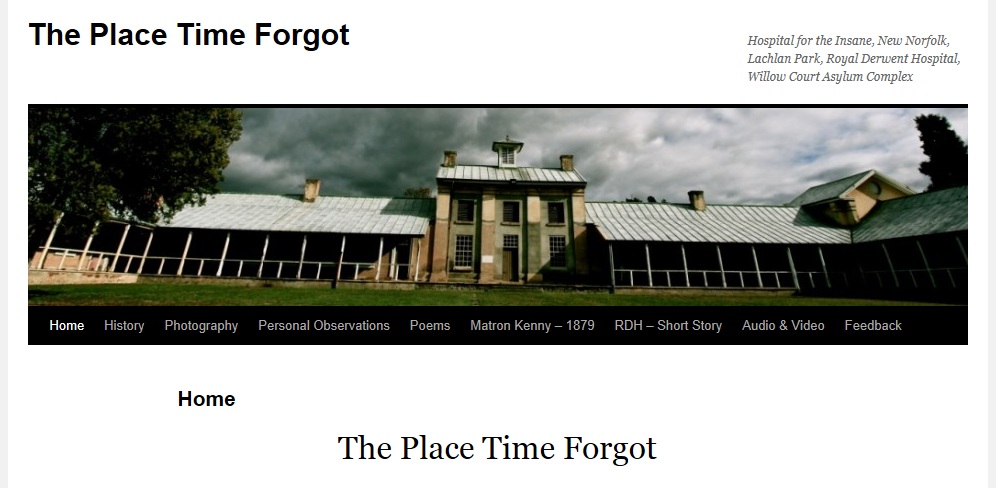
A very creative web site has emerged from a young Tasmanian Student and it contains great photography and audio interviews. It is great to have more information about Willow Court and it’s history in the public domain and should raise the profile of Willow Court as a place of importance. The owner, who made contact with us on the last open day has given us permission to share links. This is a really positive story and it’s great to see younger people interested in Tasmanian Disability/ Mental Health, and Architectural History. https://willowcourttasmania.org/links/
Cheers
Mark
Rod Quarrell Restorer
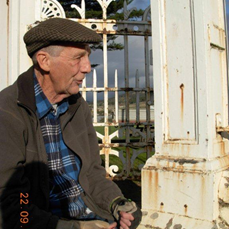
Rod Quarrell sizing up the work on the Willow Court gateway
Rod has worked on many heritage properties around Tasmania, including Port Arthur and has volunteered his expertise and time to restoring the beautiful old gates that face the New Norfolk township. After a chance meeting with a member from the Friends of Willow Court Committee, conversations soon came round to the restoration of the site which happened to be a passion of Rods too. Rod’s interest and expertise in heritage properties such as Willow Court have lead to our first restoration project on 7/8 Oct.
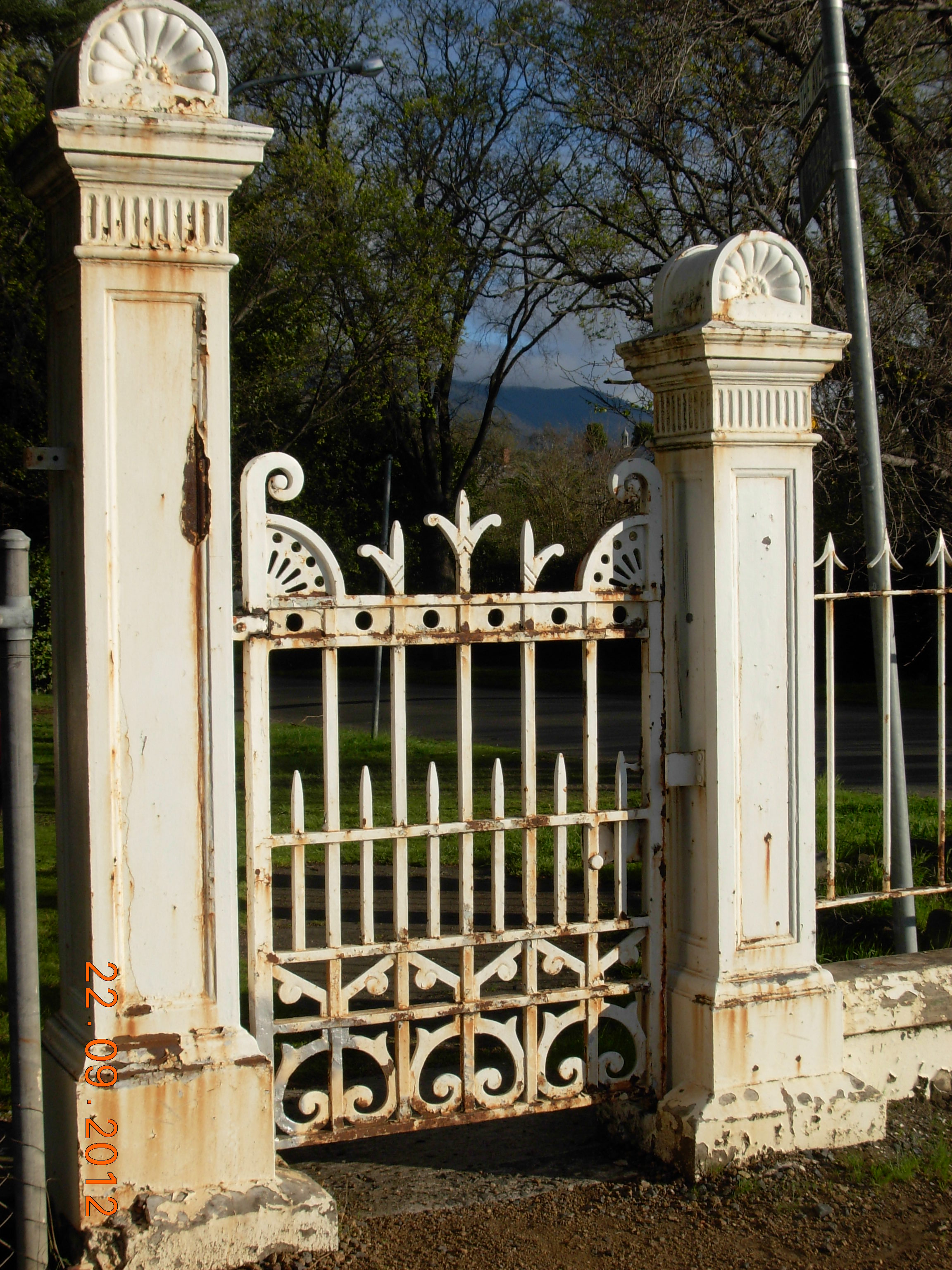
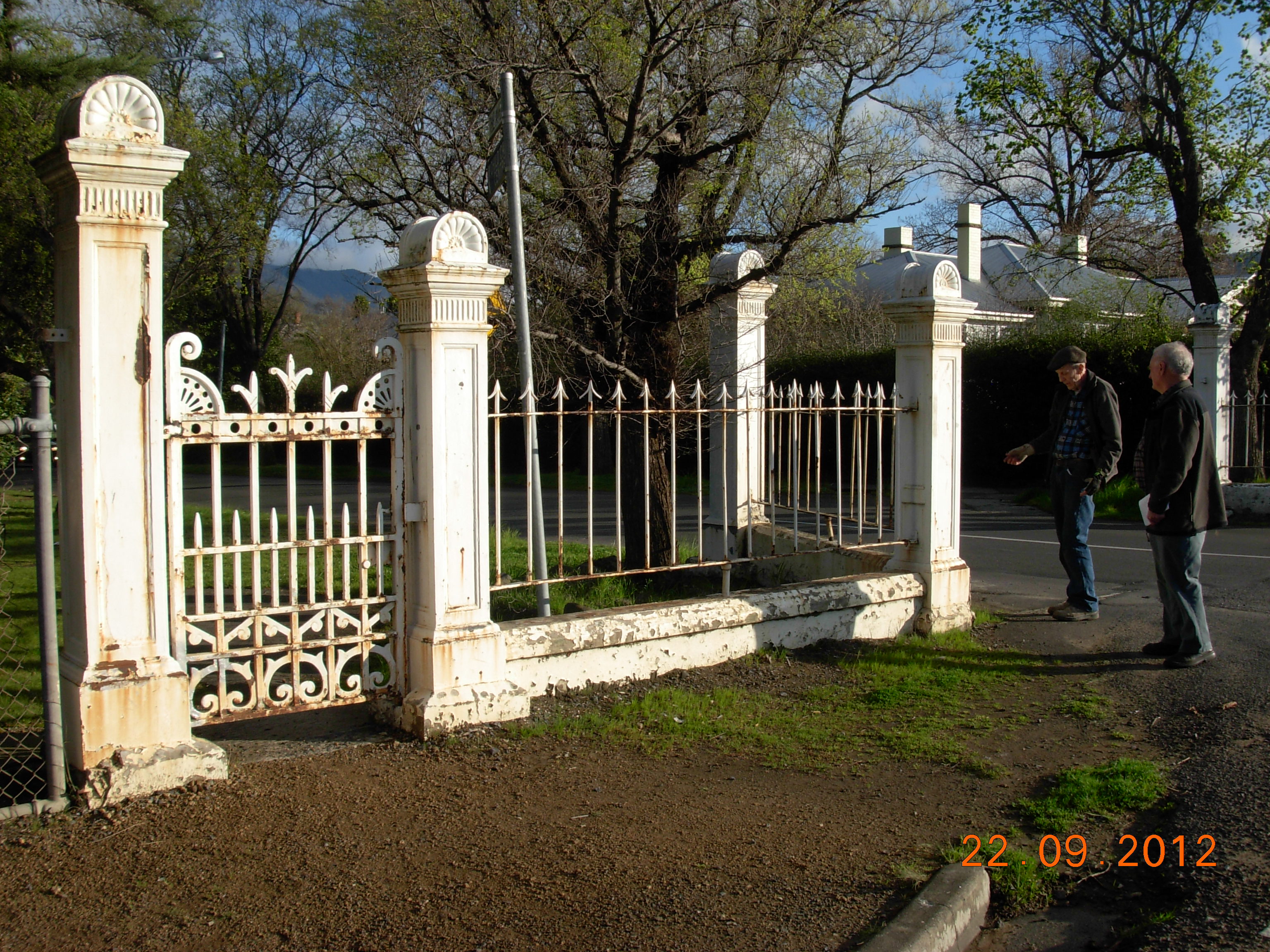
Friends of Willow Court have initiated this project and have been granted a Works Exemption by Heritage Tasmania. Four to six volunteers from FoWC will assist Rod on the first weekend in October.
Cheers
Mark
Exploring the purpose and methodology of establishing a “museum of memory”
I think this article has implication for our current situation and determining our own responses in the creating of a museum of memory, whether it is a physical buildings or words in a book or a website, all these complex issues will take time, understanding and a great deal of patients.

“Those who cannot remember the past are condemned to repeat it” The exercise of memory is but one of the four essential tasks of a post Government Policy of Institutionalization if it is concerned with healing and reconciling the past practices for PWD, the other three are: truth, justice, and reparation.
This entails giving the victims and their kin the chance to recover their dignity and validate their experiences. This can only be done if their stories are allowed to be freely told, collected, and preserved. These stories must be situated in the broader context of the events that marked that period.
From all this, wrote the Jewish philosopher Avishai Margalit in his thought-provoking work, “The ethics of memory,” we may glean an ethics of remembering that must be distinguished from the politics of memory or the psychology of memory. An ethics of memory implies an obligation to remember and also to forget. It involves complex attitudes and sentiments that come with what he terms “thick” relations—relations that are “moored in shared memory.”
“Thick relations are grounded in attributes such as parent, friend, lover, care provider, fellow-countryman.” The operative themes that mark such relationships are those of loyalty and betrayal, gratitude and love. “Thin relations, on the other hand, are backed by the attribute of being human.” These are our relationships to the “stranger and remote.” Here, the operative themes are usually those of respect and humiliation. Margalit says that ethics refers to how we should live with those who are bound to us by shared memory. Morality refers to the rules that govern our relationships to the rest of humanity.
Read in this context, it becomes clear that the project of a museum of memory has to confront the tricky issues posed by the ethics of remembering. This cannot be done by a committee working separately from the communities of memory that alone must decide what to remember and what to forget. The purpose must be neither merely to exhibit the trauma of the past nor to demonize the perpetrators. If it is to succeed, a memory museum cannot have any other purpose than to reawaken the values of loyalty, forgiveness, gratitude, and solidarity that hold us together as a people bound by thick relations.
Adapted from the work of
By Randy David, Philippine Daily Inquirer
12:24 am | Thursday, September 20th, 2012
Dr Dianne Snowden Profile

Dr Dianne Snowden was appointed as an ex officio member of the new Conservation Committee. She brings a wealth of historical knowledge and expertise to the committee. She is a Hobart-based geneaological researcher and historian and has been a member of the National Archives of Australia Advisory Council since June 2008. She is also a Consultant to the Professional Historians Association (Tasmania) Inc and is the Convenor of the Friends of the Orphan Schools St John’s Park Precinct.
Dianne is an historian who has made a significant contribution to the field of historic heritage. She is a member of the Board of the National Trust of Australia (Tasmania), the Board of the Female Factory Historic Site and a member of the National Archives of Australia Advisory Council. Dianne has a particular interest in the history of convict women and their children, reflected in her work on the Orphan School, St John’s Park Precinct. She is an Honorary Research Associate at UTAS and conducts an annual Winter School there on researching family history.
“I am particularly interested not only in making records widely available and easily accessible to the public but also in educating users in understanding the potential of the records and how to use them effectively. I have a particular interest in seeing that significant groups of records are preserved for future research. I also value the promotion of Australian history, especially 20th century Australian history, to schools and tertiary institutions.”
We believe that Dr. Dianne Snowden will be a real asset to the Conservation Committee.
Tender to connect power to site
Today’s Mercury has an advertisement calling for tenders to connect power to the Willow Court site. this has been the next big step that is needed at Willow Court. It will secure the site, allow someone to live nearby or at the site for added security and it will also allow reconstruction, restoration and exhibits to take place. Well done to the Conservation Committee and the DVC for moving so fast on this very basic by important step forward, it’s yet another good news story.
Cheers
Mark
Staff log book from 1928 found
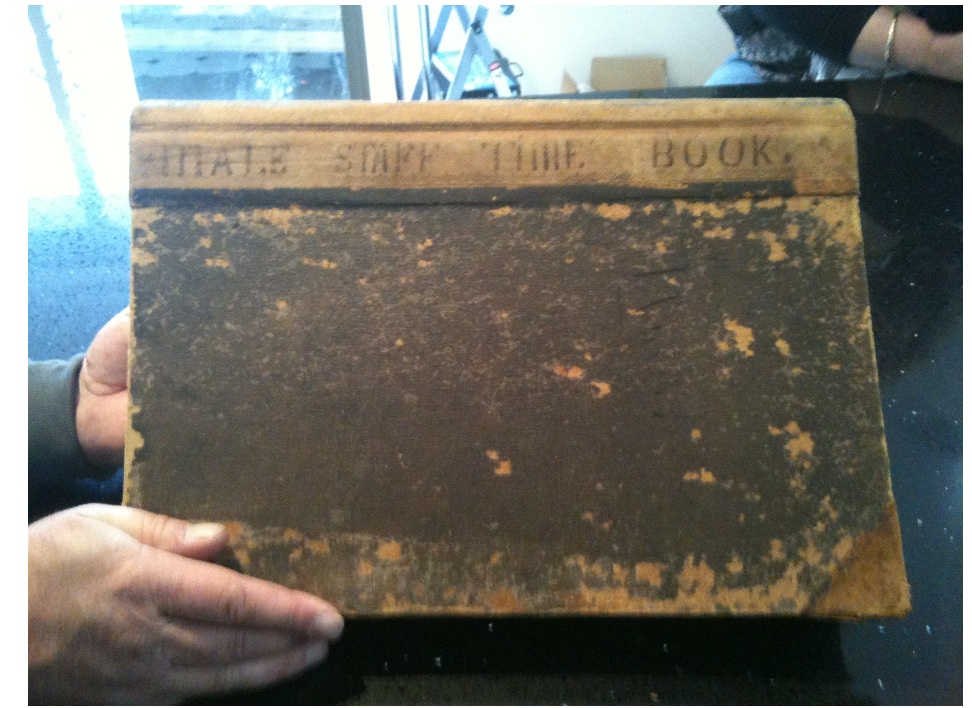 An old leather bound Willow Court (1928) staff log book has been found after looking through a family member’s estate. This has been offered to display at Willow Court. It would be wonderful to see artefacts return to a place where they will be safe and sensitivety displayed. We hope that this will happen with the Conservation Committee soon and thank the donor for that offer.